 LMM Guide
Audio
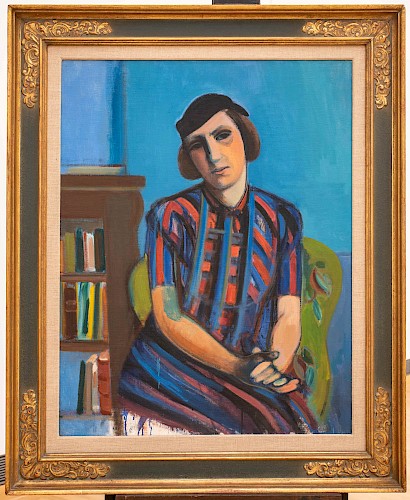
Levy, Rudolf: Margot Lachmann (1892-1970), c. 1928, Inv. 87/23, oil on canvas
GDKE, Landesmuseum Mainz
Margot Lachmann - Rudolf Levy
Rudolf Levy, who was persecuted by the National Socialists, was a successful and respected artist in Berlin in the 1920s. Around 1928, he painted Margot Lachmann, the sister of his wife Eugenie. Based on the approach of his teacher Matisse, color was his primary means of expression and design.
Margot sits on a green-patterned armchair in a room painted a vibrant blue. Her dress with a blue and red stripe pattern, like her short-cropped hair and tight hat, is entirely in keeping with the fashion of the Weimar Republic. The bookshelf in the background is possibly a reference to her profession as a writer. Despite her colorful dress, her posture radiates a depressed, by no means cheerful mood. Levy paints the woman in her mid-thirties with broad, flat brushstrokes; the shadows on her arms, hands and face are turquoise, which, together with the dark, black eyes, further emphasizes the sitter's melancholy expression.
Margot Lachmann, née Schindler, emigrated to the USA with her husband Kurt in 1937.



mobilewebguide LMM Guide
wird geladen ...

Ein Angebot von satelles.de:
erfahren - erleben - entdecken
 Android
 IPhone