 LMM Guide
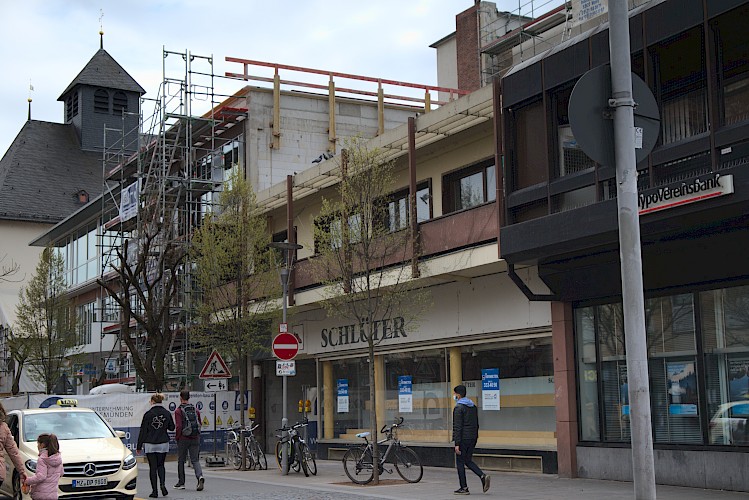
Schuhhaus Schlüter
GDKE, Landesmuseum Mainz
Manes shoe store
The Manes shoe store had been owned by a Jewish family for three generations. Founded by grandfather Lambert Manes, it was owned by his grandson, Friedrich Salomon, in 1930. The National Socialists’ rise to power also changed the lives of the Salomon family.
After the war, Gerti Salomon reported on these years, which she experienced as a teenager (ibid., p. 46):
"[My father's] business was going well until 1 April 1933, the day of the boycott. Since the boycott [...] the customers have stayed away. In addition, many of the employees my father had trained turned out to be staunch Nazis who watched my father's every business move with suspicion. The agitation against Jews increased. Not only in the relevant party gazettes such as the "Völkischer Beobachter" and the "Stürmer". The largest local newspaper in Mainz, the "Mainzer Anzeiger", had also long since adopted the diction of the men in brown. At some point, my father realized that he could no longer run the business. In 1936, he sold the traditional shoe store to his director Anni Schlüter. It was a fair deal, if you could still call it a fair deal back then [...] My father suffered a lot from the sale of the business. His life's work, the content of his life, was gone."
An annotated photo of the Manes shoe store from 1919 can be found here: https://stolpersteine-guide.de/map/biografie/871/anny-salomon
The eldest son of the Salomon family fled to South Africa in 1936. The parents and Gerti Salomon remained in Germany and experienced discrimination, oppression and the violence of the November pogroms over the next few years.
Fritz Salomon did not think about escaping. He hoped for a long time that the brown spook would soon be over – until the early summer of 1939, just a few months before the start of the Second World War. Fritz Salomon also seemed to be thinking about fleeing Nazi Germany. He needed money: for the travel costs, fees and collateral to be deposited, and for start-up capital for a new beginning. However, the National Socialists hindered the preparations. Harassments such as the "Reich Flight Tax" or "Blocked Mark Accounts" ensured that as much of the refugees' money as possible was taken from them. Fritz Salomon came up with the idea of smuggling some of his money abroad illegally. His twenty-one-year-old daughter Gerti was to send two thousand Reichsmark abroad via an intermediary. They were busted! Fritz Salomon was appointed to the Mainz Gestapo office at Kaiserstrasse 31. After this visit he took cyanide. He died on 23 June 1939.
A photo of Fritz Salomon from 1939 can be found here: https://zentralarchiv-juden.de/fileadmin/user_upload/bis2016dateien/B_5.1_Abt_IV_0676.pdf
Gerti Salomon was arrested and remained in custody for sixteen months. After her release, Gerti fled completely destitute. She took an adventurous route to China, to Shanghai. Gerti Salomon survived the Holocaust there.
If you would like to see an excerpt of their conversation, click here: https://www.youtube.com/watch?v=B3agPznYuz0
Her autobiographical book "Hier sind meine Wurzeln, hier bin ich zuhause" (Here are my roots, I am home here) was published in 2010, almost 20 years after this interview.
Gerti's mother, Anny Salomon, remained in Mainz. Like Karoline Weis, she was deported to Poland in March 1942. The deportation lists with details of the "deportees" from 1942-43 from the estate of Michel Oppenheim can be found here: https://faust.mainz.de/document_start.fau?prj=internet&dm=archiv&ipos=1&zeig=63348
At the end of March 1942, Anny Salomon and Karoline Weis were told that they had three hours to leave their apartment. They were "provisionally detained" and told to pack for transportation. They were allowed to take a suitcase or rucksack weighing no more than fifty kilograms and fifty Reichsmarks. They were also to wear a sign with their name, date of birth and ID number around their neck. They were taken to the Feldberg School, where that night hundreds of people waited in the school gymnasium next to Karoline Weis for the next morning. At dawn, they were taken to the goods station on Mombacher Straße and boarded a train. More people boarded in Darmstadt. The destination of the trip was German-occupied Poland, the small town of Piaski in the district of Lublin.
In Piaski, the German occupying forces had turned the Jewish quarter into an internment camp. For these internment camps, they came up with the trivializing name "residential district" or "ghetto". Jews from Poland, Germany and Czechoslovakia were housed in the Piaski ghetto. Since the ghetto was overcrowded, the German authorities removed some of the inhabitants. It affected the Jews from Poland: They were taken to the Belzec extermination camp. Martha Bauchwitz from Stettin had been in the Piaski ghetto since 1940. She witnessed the arrival of the new transport. She wrote in a letter to her daughter: "The one thousand five hundred from Mainz, Worms and Darmstadt have come to the homes of those who are “travelling". They don't have a penny of money! They say many died on the way."
Traces of Karoline Weis and Anny Salomon are lost here in Piaski. We don't know whether they died in the ghetto. Hunger and disease were the most common causes of death there at the time. Or were they taken to Sobibor, an extermination camp where people were suffocated with engine exhaust fumes? All we know is that no one from Piaski returned to Mainz.
If you turn your back on the former Manes shoe store and walk across Gutenbergplatz with its monument past the theatre along Ludwigstraße, you come to Schillerplatz. The name of another Mainz resident is associated with Schillerplatz and stately building: That of art collector and businessman Felix Ganz.
(© GDKE, Landesmuseum Mainz)
Dieses Audio ist leider nur auf Deutsch verfügbar.


mobilewebguide LMM Guide
wird geladen ...

Ein Angebot von satelles.de:
erfahren - erleben - entdecken
 Android
 IPhone