 LMM Guide
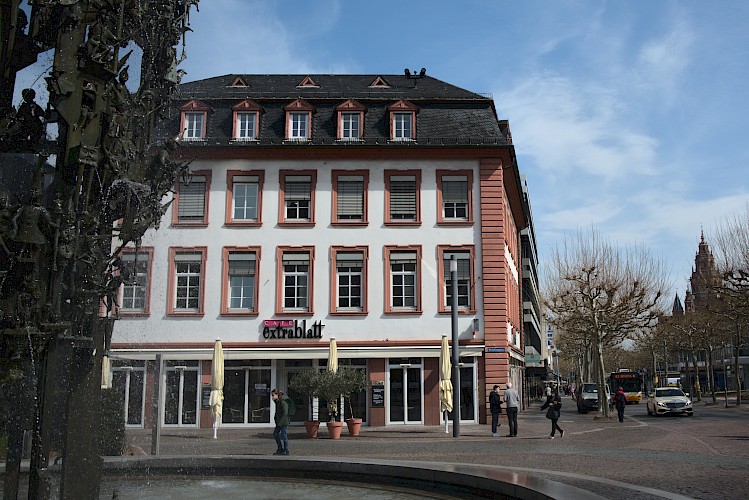
Haus am Schillerplatz
GDKE, Landesmuseum Mainz
Felix Ganz and the house at Schillerplatz
The corner building, which now houses a café, was a carpet store before the Second World War. The purveyor to the court was "Ludwig Ganz - Teppich Ganz". Even before the First World War, the company was one of the largest importers of carpets in Germany. Felix Ganz inherited the business from his father and continued to expand it.
Felix Ganz was not only an entrepreneur, he was also a patron of the arts: He supported the Mainzer Liedertafel, the Mainzer Altertumsverein, the Römisch-Germanisches Museum – a Mainzer with a commitment to his home town.
When the National Socialists came to power in 1933, none of this mattered because Felix Ganz had Jewish ancestors. Although he had himself and his children baptized, he remained a Jew according to the racist worldview of the National Socialists. Even the fact that he fought for Germany as a soldier in the First World War was of little use to him. His business was "Aryanized", meaning that he was forced to hand over his business to his non-Jewish authorized signatory.
His family was persecuted and his grandson Peter Ganz was deported to Buchenwald concentration camp in 1938. The Ganz family then fled Nazi Germany to England and Switzerland. Only Felix Ganz and his wife remained. In 1941, they had to leave their house in what is now Volkspark and a Gestapo officer moved in. Felix Ganz also had to move into a Jewish house. Felix turned seventy-three on 27 September 1942 – the day of his deportation to the Theresienstadt concentration camp. Two years later, Felix Ganz and his wife Erna were murdered in Auschwitz.
Felix Ganz had a large art collection. The art collection has disappeared to this day, but the search is on. A research project at the University of Mainz, which is funded by the German Lost Art Foundation (Deutsches Zentrum Kulturgutverluste), is searching in Germany and internationally with the help of Felix Ganz's great-grandson. But so far there have only been a few successes.
The Mainz State Museum owns a few works of art from Felix Ganz's home, for example, an eighteenth-century baroque chest of drawers and a painting by Konrad Sutter. This is also known from provenance research at the museum.
What happened to the artworks of the Jewish art collectors? The tax office played a central role in this. The branch office of the tax office for Mainz Mitte is still located on Münsterplatz. On the way there, you pass the Schiller monument and the Schönborner Hof. The Schönborner Hof had been the headquarters of the NSDAP district leadership and several Nazi organizations since 1933. At the end of Schillerstraße, past the Proviantamt, you reach the aforementioned branch in house no. 13, just before Münsterplatz.
(© GDKE, Landesmuseum Mainz)
Dieses Audio ist leider nur auf Deutsch verfügbar.


mobilewebguide LMM Guide
wird geladen ...

Ein Angebot von satelles.de:
erfahren - erleben - entdecken
 Android
 IPhone