 LMM Guide
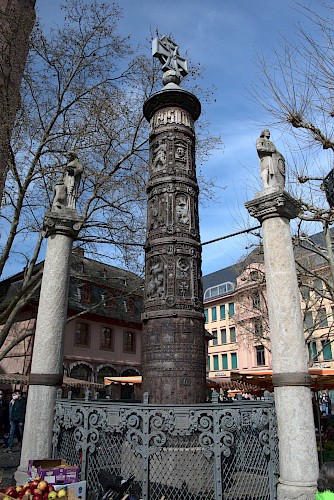
Die Nagelsäule
GDKE, Landesmuseum Mainz
The Nail Column
Here on Liebfrauenplatz, surrounded by a metal grid and three stone columns, stands a seven-meter-high column, the Nail Column.
Take a close look at the Nail Ccolumn: You recognize thousands of nail heads and some weathered reliefs. The nail heads produce lettering and slogans, often with patriotic content.
The Nail Column was erected in 1916 in the middle of the First World War. Anyone who wanted to could buy a nail and have it hammered into the wooden pillar. The proceeds were earmarked for a humanitarian cause: The donations were intended to support the suffering population in the second year of the war. Around thirty thousand people took part in the fundraising campaign at the time. A simple nail was available for one Reichsmark, a nail with a gold-plated head cost twenty Reichsmarks.
Many Jewish Mainz residents also took part in this campaign. They wanted to show their social commitment but also saw their participation as their national duty, as many Jews saw themselves as patriotic Germans. The list of donors is preserved in the city archives. The entry with the number 192 lists the then-15-year-old Netty Reiling, who later became the writer Anna Seghers. Many clubs, companies and associations took part. The Catholic Church donated a rosette and a picture of St. Boniface, while the Protestant Church donated a Luther rose and a monogram of Christ. The Jewish community also took part. Traces of this can still be found today.
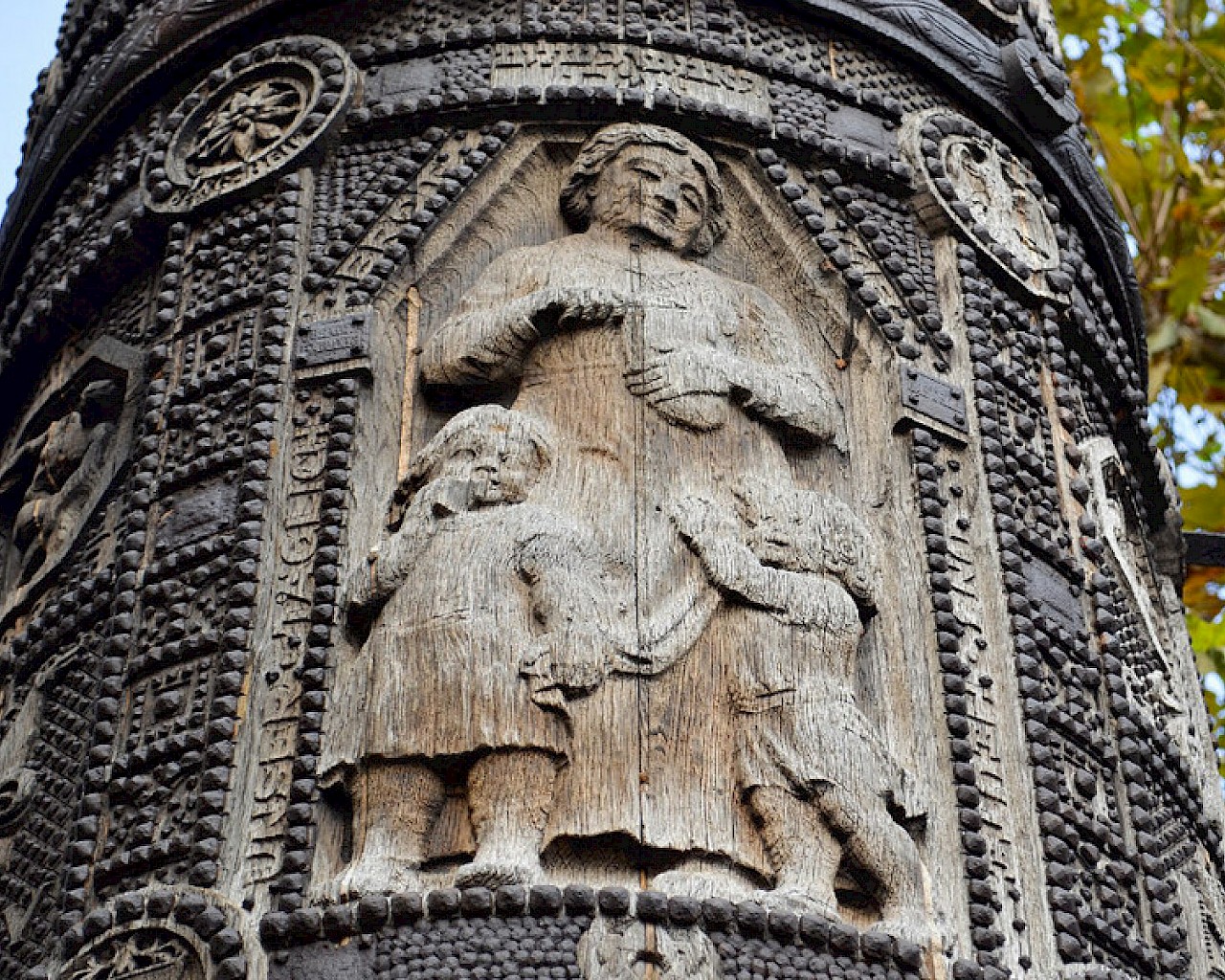
There are three bands with pictures in the middle of the column. In the lower picture zone, there is a picture of a woman cutting bread for two small children. A Star of David is at their feet. An inscription can still be conjectured in the band above the woman. Here it says in Hebrew letters: "You shall love truth and peace" a quote from the Hebrew Tanakh. This quote is also in the Christian Bible.
The Nail Column shows the successful assimilation of Jews in Germany like hardly any other testimony in Mainz. Jews in Germany saw themselves as Germans, as Germans of the Jewish denomination.
Anti-Semitism had not disappeared in the early twentieth century. However, many Jewish Germans considered anti-Semitism to be a phenomenon of the past that would soon disappear.
If you turn back, cross the market square and the "Höfchen", you come to Fuststraße, where the pedestrian zone ends today. The Schlüter shoe store existed on the left until 2019. The Manes shoe store was here until 1936.
(© GDKE, Landesmuseum Mainz)
Dieses Audio ist leider nur auf Deutsch verfügbar.


mobilewebguide LMM Guide
wird geladen ...

Ein Angebot von satelles.de:
erfahren - erleben - entdecken
 Android
 IPhone