 LMM Guide
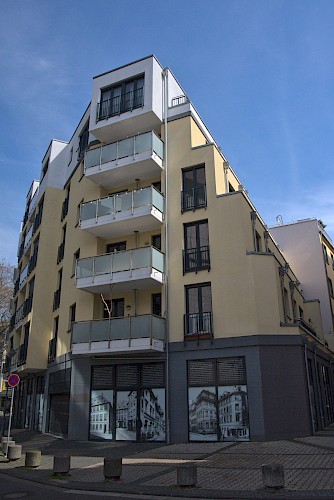
Wohnhaus von Karoline Weis
GDKE, Landesmuseum Mainz
The house of Karoline Weis
Emmeransstraße runs parallel to Margarethenstraße. Karoline Weis lived here, in house no. 45. The house has not been preserved. It stood on the right-hand side, where the trees are today.
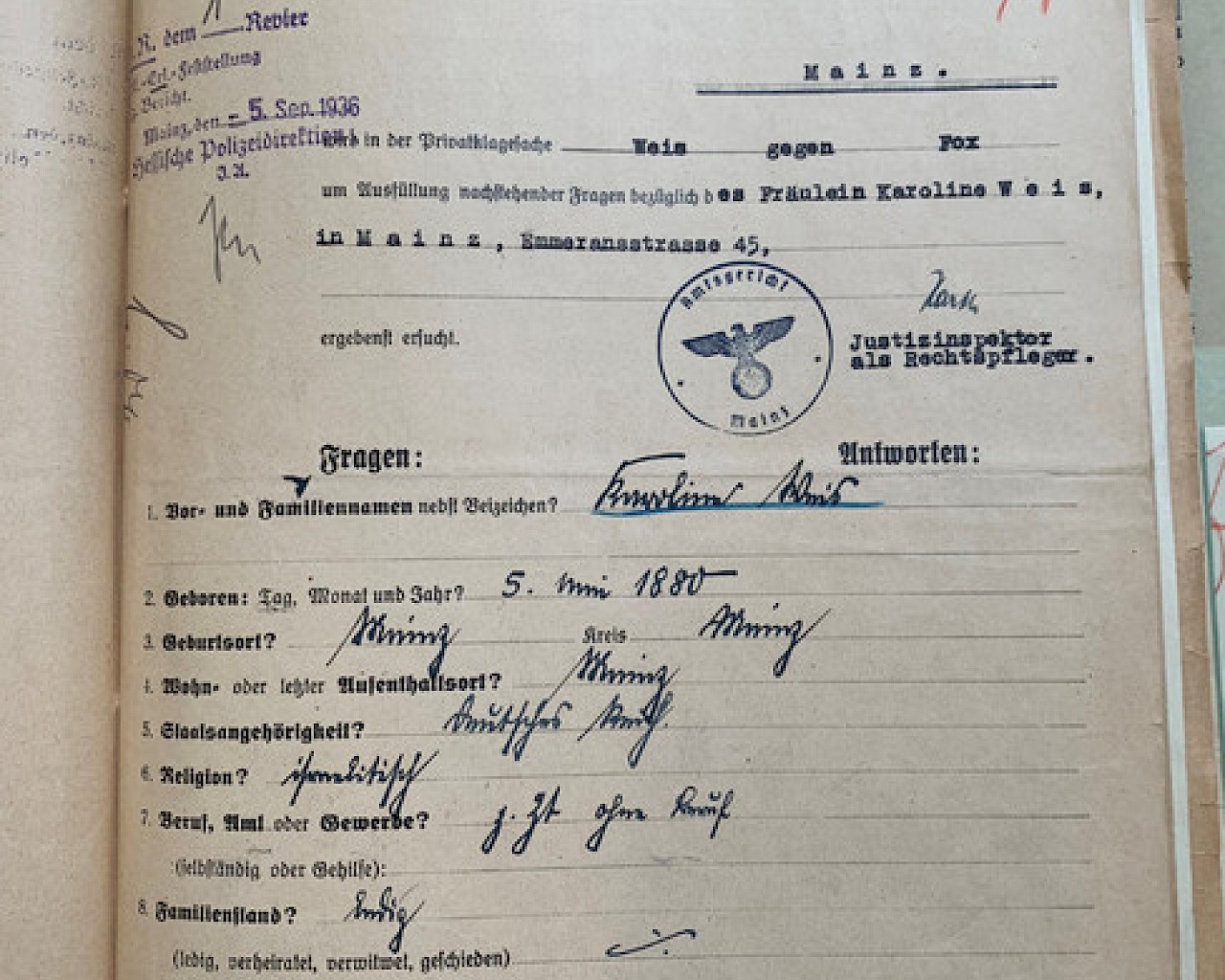
In this environment, Karoline Weis had to bitterly experience everyday anti-Semitism in the summer of 1936. She had to give up her apartment in Walpodenstrasse. Like Gerti Salomon, she experienced hostility and abuse but did not want to incur it and fought back. There was a dispute between neighbours, verbal abuse and insults. Ms Weis was defamed as a "Saumensch” (sow human) and was chased off the street under threat. Karoline Weis pressed charges. Lawyers were appointed and witnesses were to be heard. The surviving court records show the blatant anti-Semitism of those involved. The opposing lawyer demanded that the proceedings be discontinued because:
" ... the plaintiff is Jewish and has recently attracted a lot of attention as such. Even her co-religionists moved away from her, which is saying a lot."
Moreover, Ms Weis was also poor and dependent on public legal aid. A trial would incur costs that the state coffers would have to bear. Karoline Weis was burdened by the dispute with her neighbours. She informed the court that she was temporarily moving in with her relatives in Frankfurt. In doing this, she kept her distance from her spiteful neighbours.
On the surface, Karoline Weis' complaint sounds like a normal neighbourhood dispute. But in 1936, a dispute between a Jew and a non-Jew was no longer purely personal, but also political. Jews experienced the National Socialist dictatorship as a time of continuous humiliation. The authorities were constantly inventing new anti-Semitic regulations. The Nuremberg Laws of 1935 were an early culmination of this. They determined that Jews were no longer citizens with equal rights. They were no longer “Citizens of the Reich", but only: "Nationals".
Many ordinary Germans realized that they could humiliate Jews with impunity, covered by the state, and many took advantage of this.
Ms Weis' complaint came to nothing. That same autumn, Karoline Weis moved into a new apartment at Zanggasse 22.
To get an idea of what this neighbourhood looked like before the war, take a look at the enlarged historical photos on the glazed first floor of house no. 38 on the opposite side of the street. Back then, this part of Mainz's old town also looked like a cosy quarter.
Today's Kaufhof is the next stop on the walk. You can get there by turning left into Ottiliengasse, so that you have the back of the Dalberger Hof on your right. During the Nazi era, the Dalberger Hof was home to the police headquarters with its dreaded police prison. Finally, you come to Schusterstraße and the main entrance to the Kaufhof department store.
(© GDKE, Landesmuseum Mainz)
Dieses Audio ist leider nur auf Deutsch verfügbar.


mobilewebguide LMM Guide
wird geladen ...

Ein Angebot von satelles.de:
erfahren - erleben - entdecken
 Android
 IPhone