 LMM Guide
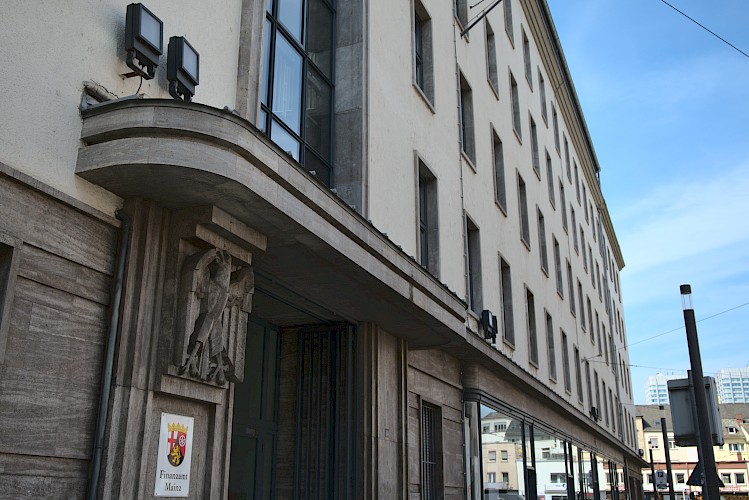
Finanzamt
GDKE, Landesmuseum Mainz
The tax office
This building and the neighbouring Telehaus signalled that modern construction had moved into Mainz's old town at the beginning of the 1930s. Since then, an imperial eagle has guarded the entrance portal. When it was completed in 1931, it was still a symbol of democratic Germany. However, the imperial eagle was soon supplemented by the swastika and became the symbol of the dictatorship.
Tax offices played an important role in the plundering of the Jewish population during the National Socialist era. They organized the taxation of refugees from Nazi Germany and levied the "Reich Flight Tax". The money paid in the forced sales of the so-called Aryanizations was paid into blocked accounts. The responsible tax office monitored the accounts and determined the monthly amount that the Jewish sellers were allowed to dispose of. Tax offices collected special taxes for Jews. The so-called "Jewish property levy" was particularly cynical, because after the November pogroms Jews, i.e. the victims themselves, were supposed to pay for the clean-up work and the removal of the ruins. A law passed in 1941 completed the exploitation. All Jews who left Germany, including forced deportees such as Karoline Weis and Felix Ganz, were to lose their assets.
Once again, the tax offices were willing helpers. They assessed the remaining valuables and savings accounts of the refugees and deportees. They appointed the experts who appraised the works of art. The expert determined that all important artworks from Mainz should go to the Mainz Museum. The Mainz Picture Gallery, the predecessor of the State Museum, accepted these allocations. The picture gallery thus participated in the expropriation of the Jews.
In October 1945, the first Jewish service was celebrated in Mainz after the end of the war. About twenty believers came. Before the war, the Jewish community had over two thousand six hundred members. Over the next few years, only a few Jewish Mainz residents returned from the camps or exile. A new beginning was difficult. The cities were destroyed and German society treated the returnees with suspicion.
Gerti Salomon survived the Holocaust. It was not until 1950 that she returned to Mainz for the first time. She reports on her search for her father's antiques (ibid., p. 111 ff.):
"I went to the former Jewish house, which had been my mother's last home before she was deported.
The woman who opened the door for me had a pinched face. She was an elderly person whom I knew briefly from before, when she had cared for the disabled son of a wealthy Jewish family.
'Oh, Miss Salomon,' she exclaimed in astonishment, 'you're still alive?
'Yes, I'm still alive,' I said. 'I'm visiting for a moment and just wanted to say hello
After some hesitation, she let me into the apartment. When I entered the living room, my heart sank. There was the bookcase with all the books that my father had carefully labelled with his bookplate. On the front of the cupboard was written in Gothic letters: 'Labor omnia vincit!' – 'Work conquers all' – my father's motto. And there was this beautiful Gothic table that had adorned the drawing room of our apartment in Kaiserstrasse for all those years. I said: 'How nice of you to keep the old things for me
She replied: 'Kept for you? Your mother gave it to me!'
I said: 'But this is my inheritance. I'm attached to it. These items are the last memory I have of my parents. I'll buy you a new bookshelf and a new table. Then you'll be rid of the old stuff
The old woman huffed. It was an unpleasant conversation. But in the end, she was prepared to hand over the bookcase and the table."
After 1945, many refused to hand over the looted property of their Jewish fellow citizens. Public institutions did the same, and museums were no exception. Today, German museums are facing up to their responsibility. Provenance researchers are looking for the heirs of the owners. With this walk, the State Museum wants to show that this is a necessary task.
It's not far from Münsterplatz back to the State Museum. Walk twenty meters further to the Große Bleiche and turn right. On the way to the State Museum, you will come across stumbling blocks. Those who know the history of some of Mainz's Jews may view them with a new perspective. They mark stages in the lives of people who collected art, ran businesses, went to school and felt like citizens of Mainz.
(© GDKE, Landesmuseum Mainz)
Dieses Audio ist leider nur auf Deutsch verfügbar.


mobilewebguide LMM Guide
wird geladen ...

Ein Angebot von satelles.de:
erfahren - erleben - entdecken
 Android
 IPhone