 LMM Guide
Audio
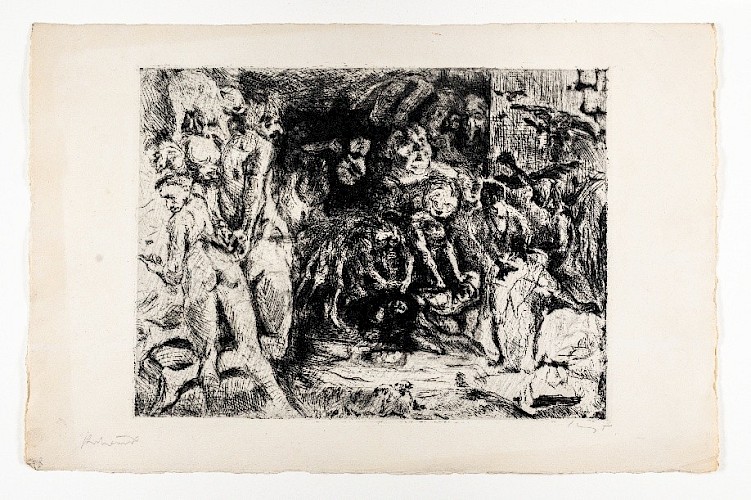
Max Slevogt, The Torment of Hell, page 11 from Shadows and Dreams, 1924, drypoint etching, GDKE, Mainz State Museum, inv. no. DL SL NL 2025/11
GDKE, Landesmuseum Mainz
Shadows and Dreams
In 1926, Bruno Cassirer published the series Shadows and Dreams. The prelude is a self-portrait. Slevogt thereby immediately makes it clear: this is about exploring his own shadows.
The Torment of Hell page demonstrates this particularly impressively. In sharp contrasts, distorted figures cluster into an oppressive composition. Hell appears here not only as a mythological place of eternal torment: it also becomes a symbol of inner distress.
The entire series comprises twelve etchings with drypoint. They refer to literary and mythological material, including Shakespeare’s Macbeth. A little later on, Slevogt dedicated a whole series of lithographs to this work, which was published by Cassirer in 1927.
Slevogt’s grim visions are more than taking pleasure in horror. They are a serious attempt to confront the human abyss.
In 1922, Slevogt had set up his own printing workshop at Neukastel, where he experimented primarily with etchings together with his brother-in-law Walter Finkler. One of the first major projects was the series “Shadows and Dreams”, of which Slevogt produced a special edition himself. In a letter dated 3 October 1924, Max Slevogt asks Cassirer for his opinion as to whether the prints have been successful.
Dear Cassirer,
[...] Take a look at the latest “Shadows and Dreams” prints by my brother-in-law. I place immense value on your opinion. I try – (the drypoint is of course the purest graphically – simple etching, too –) to make use of intermediate tones – in printing especially! – but not in a way that can so easily give the page a photomechanical, engraving-like character, but rather a loose, permeable form. – For me, it is important now to hear to what extent your preconception (which is perhaps justified – but nevertheless leaves the boundaries too narrow) butts up against this. [...]
Warmest greetings from all of us. Yours, Max Slevogt


mobilewebguide LMM Guide
wird geladen ...

Ein Angebot von satelles.de:
erfahren - erleben - entdecken
 Android
 IPhone