 LMM Guide
Audio
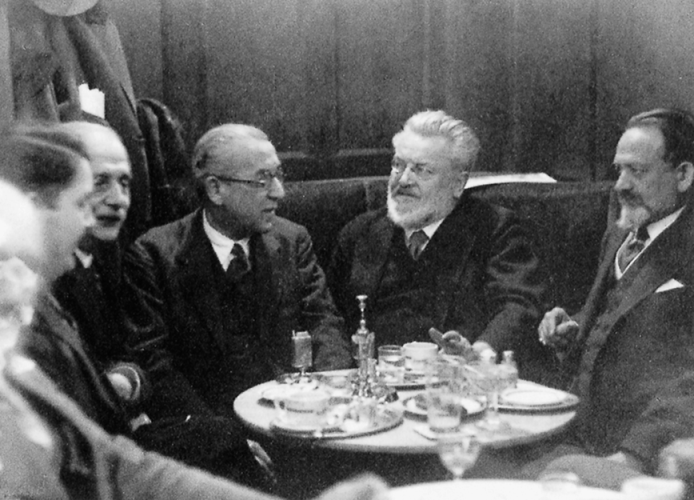
Max Slevogt in the Romanisches Café (from left to right: his son Wolfgang, Rudolf Levy, Max Slevogt, Emil Orlik), around 1930
GDKE, Landesmuseum Mainz
Regulars’ table in the café
The Romanisches Café in Berlin is a well-known artists’ meeting place. It was located east of the Kaiser Wilhelm Memorial Church in Charlottenburg. It becomes Max Slevogt’s favourite place, especially in the 1920s.
Here he sets up his own regulars’ table for artists. In addition to Bruno Cassirer, many well-known painters meet up there – including Rudolf Levy, Max Liebermann, Emil Orlik and Otto Dix. Writers, directors and actors also come and go in the café.
For many illustration projects, regular meetings are necessary. Artists, publishers and editors must work closely together. But Slevogt hardly ever appears in the publishing house. Consequently, the meetings usually take place in the Romanisches Café.
Slevogt has loved this place for years. The publishing team is forced to adapt to him in order to get the work moving forward.
This becomes even more the case for Faust II. Ultimately, Slevogt does not want to come to the publishing house at all anymore. Thus, he signs the last test prints right there at the regulars’ table in the Romanisches Café.
In a letter dated 30 November 1928, Bruno Cassirer tells Max Slevogt about the renovation of “your” regular café. Slevogt had been in the Palatinate for quite a while at this point and had therefore not been in his café in Berlin for a long time.
Dear Slevogt!
Our letters crossed in the mail. […]
The “Romanische” has changed considerably. Through the installation of the gallery, it has gained a lot in tastelessness and as a result looks much more like the archetypal regulars’ café. Moreover, our usual corner has been rebuilt and made more comfortable, so you can come back without worrying about that. Topics of conversation are also circulating again, ever since it turned out that the 20 – 30 van Goghs that resurfaced last year, which sold like hotcakes, are forgeries.
Hopefully your knee issues will pass quickly.
Best regards, Bruno Cassirer


mobilewebguide LMM Guide
wird geladen ...

Ein Angebot von satelles.de:
erfahren - erleben - entdecken
 Android
 IPhone