 LMM Guide
Audio
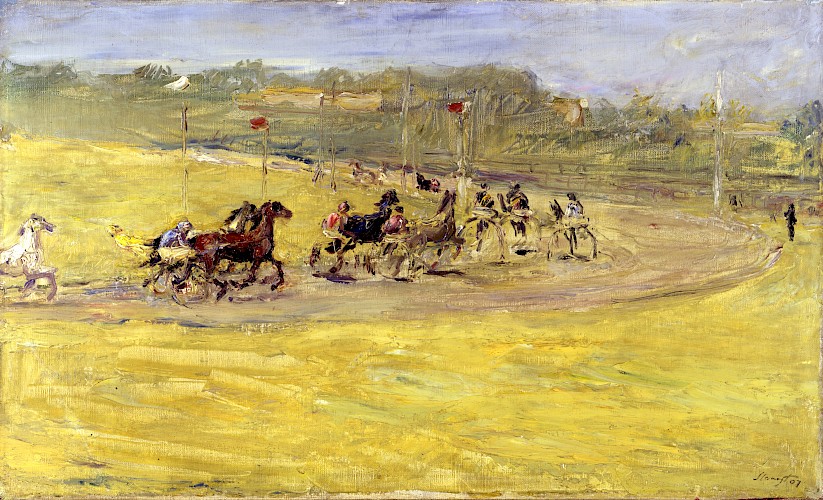
Max Slevogt, Harness Racing, 1907, oil on canvas, Staatliche Museen zu Berlin, Nationalgalerie, Inv. No. A II 144
GDKE, Landesmuseum Mainz
Horses dissolving into brushstrokes
Cassirer is a passionate horse enthusiast. Even before the First World War, he rises to become one of the most important personalities in German harness racing. He often takes the painter Max Slevogt with him to the racetrack. Here too, to Weißensee near Berlin.
This sport, new at the time, immediately leaves an impression on Slevogt. He captures the spectacle in paintings and drawings.
In the painting Harness Racing, he concentrates entirely on the speed and dynamics of the race. We see only the front of the white horse on the left. It seems to rush directly into the picture.
In the centre, the jockeys and their horses are still clearly recognisable. But at the curve, the contours become blurred. A few strokes and splashes of colour merely hint at the competitors.
The front-running sulky riders almost dissolve. Just a few brushstrokes paint an idea of them.
This makes the motif ideal for Slevogt’s fast, loose painting style, in which he takes his cue from French Impressionism.
Karl Scheffler, art critic and publicist and, among other things, long-time editor-in-chief of the monthly magazine Kunst und Künstler, has this to say about Bruno Cassirer:
“Artists, authors and horse people, paper and grain suppliers, bookbinders and stablehands sat in the waiting room and wondered about each other. […] The journey to the racecourse, the stay there in the judge’s house, the excitement of the races in which his own horses ran and often won, the summer hours in the open air and the presence of a convivial, animated crowd – all this was his counterweight to his publishing activities.”


mobilewebguide LMM Guide
wird geladen ...

Ein Angebot von satelles.de:
erfahren - erleben - entdecken
 Android
 IPhone