 LMM Guide
Audio
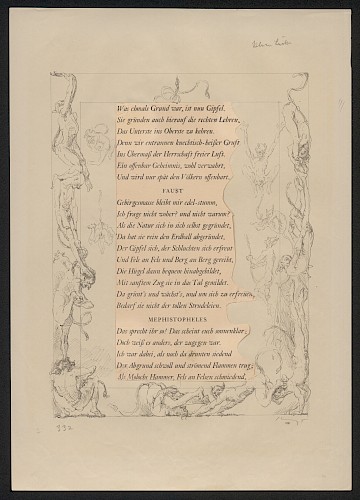
Max Slevogt, To Turn the Lower Lake into the Upper Lake, c. 1924−1926, illustrated passage, text collage, grey pen, pencil, Freies Deutsches Hochstift/Frankfurter Goethe-Museum, inv. no. III-14166/332
GDKE, Landesmuseum Mainz
180,000 lithographs
So that Slevogt knows how much space there is for his drawings next to the text, the publisher prepares templates. The publisher glues the selected text passages into these.
Beforehand, Slevogt has determined which passages from Goethe’s Faust II he wants to illustrate or frame with ornaments. He draws his designs onto the pages. These are then either transferred to the heavy lithographic stones or they serve as a template to draw directly on the stone.
The technical process is complex. First, test prints are created, followed by numerous corrections. Then the best copy is determined and this then serves as a template for all further prints.
The complete works of Faust II include a huge number of lithographs. Each individual print has to be printed around 360 times on the hand press. In total, this results in 180,000 copies.
Finally, Slevogt signs each print himself. A monotonous job that quickly bores him.
This extensive illustration project required many arrangements to be made, as shown, for example, by a letter from Bruno Cassirer to Max Slevogt dated 3 November 1924.
Dear Slevogt!
[…] I am sending you a diagram of the typesetting area, which has a double border, and am thinking of the matter as follows:
If you illustrated all the pages of the book with frames, like the poems in the Wak Wak, the result would be typographically perfect. […]
You would then have to mark those passages in the text that you want to illustrate, be it with a frame, or with half-page or full-page illustrations. Based on the margins and this information, we would first of all glue in the text of the first act, i.e. we glue the text into the outer recurring frame and on the pages that will have a special illustration, we leave the necessary space. […]
The question is whether you want to start working on the basis of this information and whether I can send you a larger number of stones for this purpose; this can be done very quickly. You would then only have to let me know immediately each time which passages you want to illustrate and to what size. At the same time, I’ll have the text set and will always tell you again how far the text and earlier illustrations extend and where there is space. Please write to me and tell me if we want to proceed like this. […]
With best regards,
Bruno Cassirer


mobilewebguide LMM Guide
wird geladen ...

Ein Angebot von satelles.de:
erfahren - erleben - entdecken
 Android
 IPhone