 LMM Guide
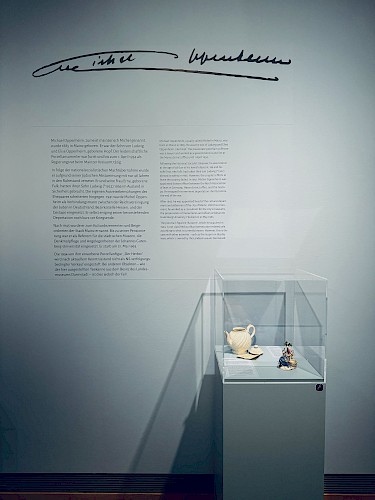
Ausstellungseinblick
GDKE, Landesmuseum Mainz
Michel Oppenheim
The case of Michel Oppenheim is a good example of the circumstances under which a persecution-related sale must be assumed. In contrast to other persecuted groups, the presumption of collective persecution applies in the case of Michel Oppenheim due to his Jewish ancestry. The burden of proof that the acquisition of the figurine “Autumn" was not a sale due to persecution lies with the museum. For sales before 15 September 1935 – when the so-called Nuremberg Race Laws were introduced – it must be shown that the seller (in this case Michel Oppenheim) received an appropriate purchase price and was able to dispose of it freely. There is currently nothing to suggest that these conditions were not met when the "Autumn" figure was acquired, which is why the purchase currently appears to be unproblematic.
For all disposals after 15 September 1935, it would also have to be proven that the legal transaction would in principle have taken place even without the rule of the National Socialists or that the property interests of the persecuted person were protected in a special manner, for example by transferring the property abroad. Disposals from one and the same collection must therefore also be researched and individually valued for each acquisition. It is therefore possible that the acquisition of the "Autumn" figurine appears to be unproblematic, but the acquisition of the Kelsterbach faience jug is clearly a result of persecution.
Link to the handout: https://kulturgutverluste.de/sites/default/files/2023-04/Handreichung.pdf


mobilewebguide LMM Guide
wird geladen ...

Ein Angebot von satelles.de:
erfahren - erleben - entdecken
 Android
 IPhone