 LMM Guide
Audio
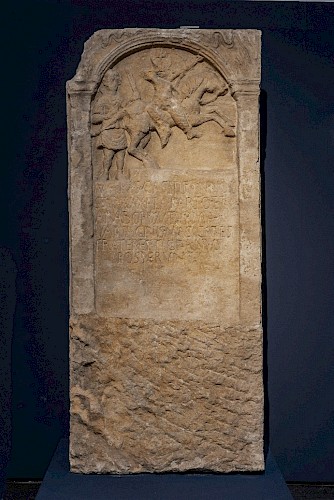
tombstone of Maris
GDKE, Landesmuseum Mainz
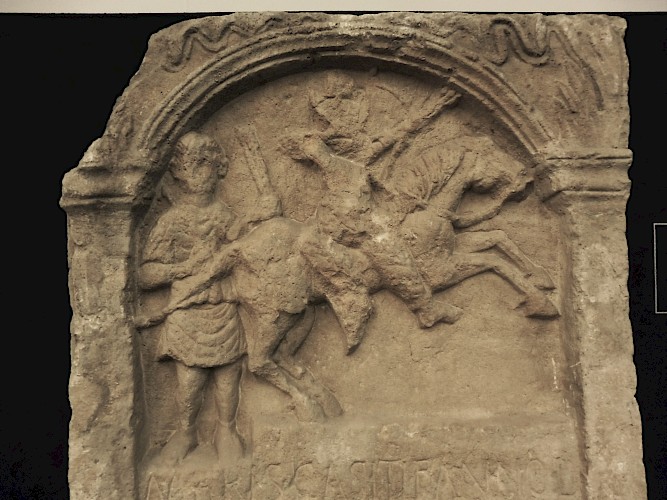
GDKE, Landesmuseum Mainz
A picture is worth a thousand words - Antiochus and Maris
Gravestones depicting horsemen were invented in Mainz. Initially, only the galloping horseman was depicted, which was later supplemented first by a horse servant (calo) and then by a barbarian under the horse's hooves. Such a calo appears for the first time on the Maris stone in Mainz. However, it differs from the later gravestones due to its size and prominent position on its own base, which protrudes into the inscription field. Possibly, the donor of the tombstone has also immortalized himself here. Maris himself differs from the usual lancers in that he is armed with a bow.
The ten-line inscription on the Antiochus stone in the Stone Hall provides a wealth of information about the deceased: The Parthian Antiochus from Anazarba in south-eastern Turkey served as a horseman in the auxiliary unit ala Parthorum et Araborum. He had completed his regular term of service as an evocatus, but served voluntarily for a further ten years. He received triple pay, which is documented here for the first time for the Roman army, and, although not a Roman citizen, was honored with military awards. A second tombstone of this cavalry troop with a pictorial representation of the deceased Maris in the Schellbau EG reveals something that the Antiochus stone omits: The ala Parthorum et Araborum was a mounted archer unit. The Maris Stone found in Mainz in the 1950s was also the first evidence of this previously unknown unit, consisting of Parthians and Arabs, which had been deployed in south-eastern Turkey and northern Syria.
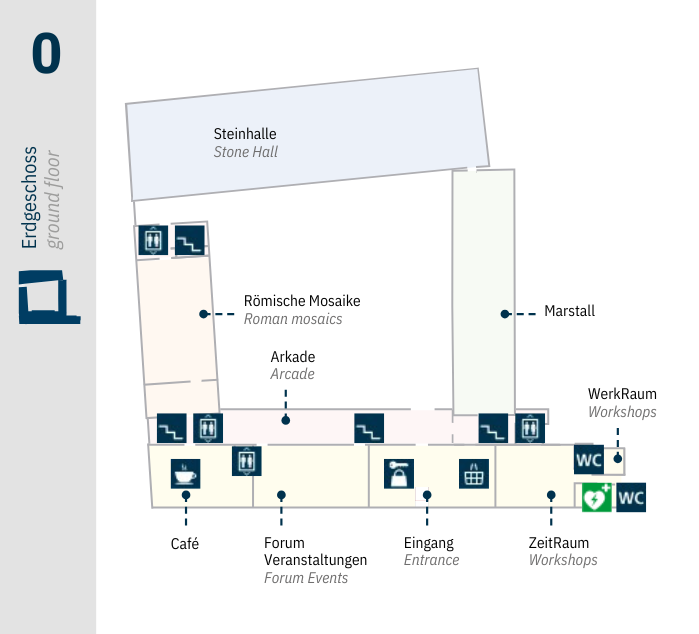

Additional information: Maris gravestone (GDKE, LMMZ)


mobilewebguide LMM Guide
wird geladen ...

Ein Angebot von satelles.de:
erfahren - erleben - entdecken
 Android
 IPhone