 LMM Guide
Audio
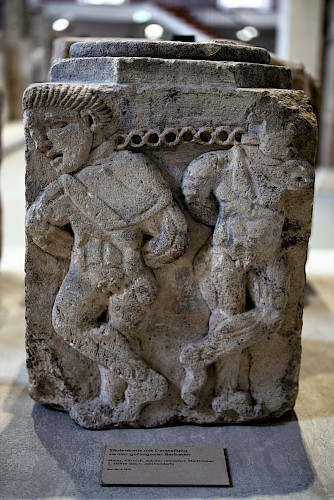
Säulensockel mit Abbildung zweier Gefangener
GDKE, Landesmuseum Mainz
Two naked prisoners
The relief belongs to a group of internationally renowned sculptures that were found on the Kästrich in the area of the former legionary camp. It adorns the front of a column base, although only the base of the column that once stood on it remains. The original architectural context of this piece is not entirely clear: either it was part of the headquarters of the legionary camp or of a colonnade along one of the main streets of the camp. In any case, the wide grooves on the sides were used to insert barrier slabs between the individual column bases. The use of Lorraine limestone shows that material was transported over long distances for the stone construction of the camp buildings, which took place in the last third of the first century. The column base had already been reused in Roman times. It was incorporated into the second Roman city wall in the fourth century, which ran over the site of the camp on the Kästrich, which had already been abandoned by that time.
The quality of the various reliefs preserved from the legionary camp is not consistent. The naked Germanic figures are depicted in a rather simple, graphic style.



mobilewebguide LMM Guide
wird geladen ...

Ein Angebot von satelles.de:
erfahren - erleben - entdecken
 Android
 IPhone