 LMM Guide
Audio
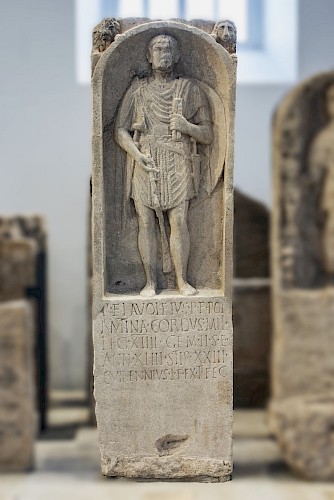
The tombstone of Publius Flavoleius Cordus
GDKE, Landesmuseum Mainz
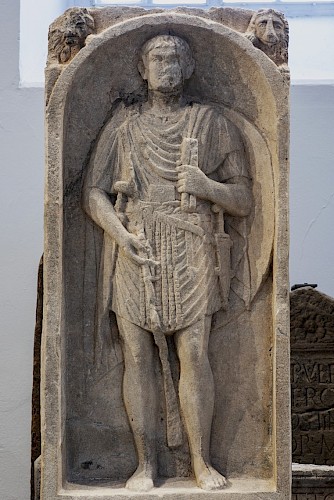
Detail
GDKE, Landesmuseum Mainz
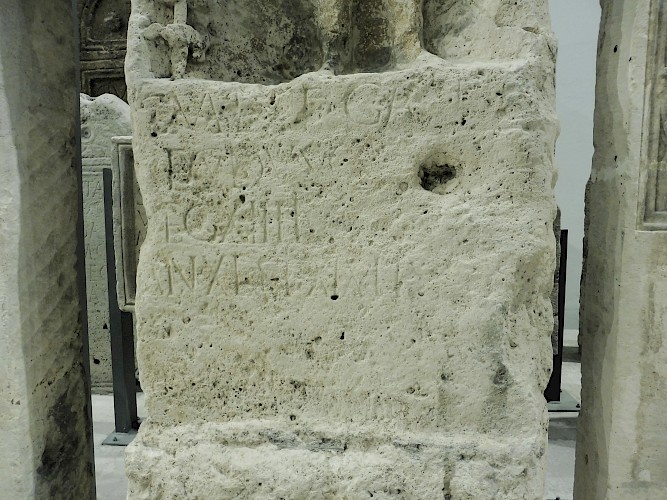
Detail with door hinge hole
GDKE, Landesmuseum Mainz
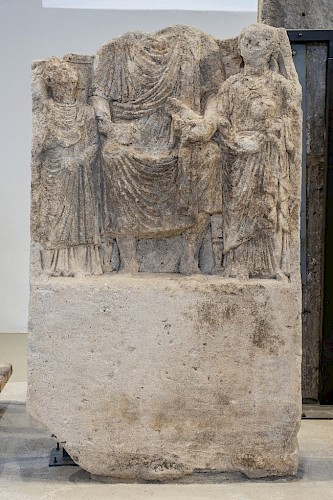
Family gravestone I from Selzen
GDKE, Landesmuseum Mainz
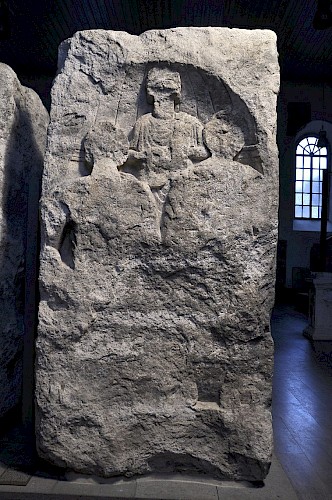
Family gravestone II from Selzen
GDKE, Landesmuseum Mainz
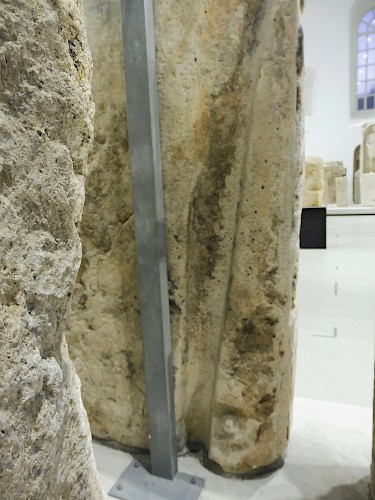
Back of the Family Gravestone II with rut
GDKE, Landesmuseum Mainz
Recycling - not new: The tombstone of Publius Flavoleius Cordus
Publius Flavoleius Cordus from Modena in northern Italy is depicted armed but without armor on his tombstone. He served in one of the two founding legions of Mainz - the 14th legion Gemina - which was stationed in Mogontiacum from 13/12 BC to 43 AD. A member of the I. Roman Cohort Opladen offers an idea of what Cordus might have looked like during his lifetime.
Recycling items is not a new invention. The Landesmuseum Mainz owes its famous stone collection to the reuse of numerous Roman gravestones and architectural elements as building material in the Roman city wall of the 4th century. However, Roman stones were also popular in the following centuries due to the quality of the stone and the already dressed ashlars. For example, an equestrian tombstone that had been shortened by the image field was fashioned into a sarcophagus and used as a tomb in Klein-Winternheim with the Cordus stone as a cover in the early Middle Ages.
Publius Flavoleius Cordus from Modena in northern Italy is depicted armed but without armor on his tombstone. He served in one of the two founding legions of Mainz - the 14th legion Gemina - which was stationed in Mogontiacum from 13/12 BC to 43 AD. A member of the I. Roman Cohort Opladen offers an idea of what Cordus might have looked like during his lifetime.
Two family gravestones found in the Selz stream near Selzen had a different fate. They were used to fortify a ford with the visible side facing downwards for quite a long time, as the deep rut on the back of one of the stones shows. The tombstone of C. Valerius Secundus was repurposed as a doorstep in Mainz. The door hinge was anchored in the inscription field and the image and inscription were worn away by the constant walking over it.

Additional information: Tombstone of Cordus (GDKE, LMMZ)


mobilewebguide LMM Guide
wird geladen ...

Ein Angebot von satelles.de:
erfahren - erleben - entdecken
 Android
 IPhone