 LMM Guide
Audio
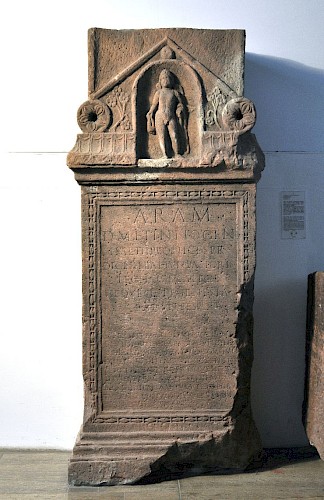
Grabaltar des Hipponicus
GDKE, Landesmuseum Mainz
Funerary monument for a child
The funerary altar („ARAM“), which was discovered in 1861 in the Mitternacht Alley in Mainz, provides precise information through its pearl-framed inscription: Hedyepes and Genesia commissioned it for the grave of their barely one-year-old son Hipponicus. They were slaves of Dignilla, the wife of Iunius Pastor, the legate of the 22nd Legion. Since Iunius Pastor held this position from 157 to 159 AD, the monument can be dated precisely. The names of the child and his parents are, as was common among slaves, Greek.
While funerary altars flourished in Italy primarily during the 1st century, they only began to appear in the northwestern provinces from the mid-2nd century onward, as this example also demonstrates. Above the large main section ("cubus") with an inscription tablet, there is a a depiction of a small temple indicated by pediment slopes. Inside its arched niche stands the figure of Cupid. It can be assumed that the funerary monument was orginially located on one of the main roads outside of the city, as was required by law, and was only later moved to the city center.

Zusatzinformation: Grabaltar des Hipponicus (GDKE, LMMZ)
Dieses Audio ist leider nur auf Deutsch verfügbar.


mobilewebguide LMM Guide
wird geladen ...

Ein Angebot von satelles.de:
erfahren - erleben - entdecken
 Android
 IPhone