 LMM Guide
1950-1999 After the Shoah
In autumn 1945, new Jewish communities are established in Mainz, Koblenz, Trier, Bad Kreuznach and Landau, and the first new prayer rooms are set up.
Predecessor: The German-Israelite Community Association (1869-1933) was the first national umbrella organisation of Jewish communities in Prussia and the German Empire.
In Rhineland-Palatinate, denazification is officially deemed to have been completed in September 1951. The Spruchkammer (denazification tribunals) processed a total of 299,562 cases (among 2.75 million residents at the end of 1946). The culprits were assigned to different categories depending on the severity of their guilt. Denazification did not, however, legally process the injustice experienced by the Jews.
On 8 November, the State Association of Jewish Communities of Rhineland-Palatinate is founded as a consortium of Jewish congregations in Rhineland-Palatinate. It is based in Mainz. The State Association is a member of the Central Council for Jews in Germany.
The recovery and reconstruction of Worms synagogue is completed. The project is controversial, not least because it initially seems unlikely that a Jewish community will ever be established in Worms again. The synagogue is inaugurated on 3 December.

The holiday retreat of the Central Welfare Board of Jews in Germany (ZWST) in Bad Sobernheim, which dates back to the 1950s, is developed into a modern rehabilitation centre. The location is now available for holiday breaks for children and young people, as well as for adults.
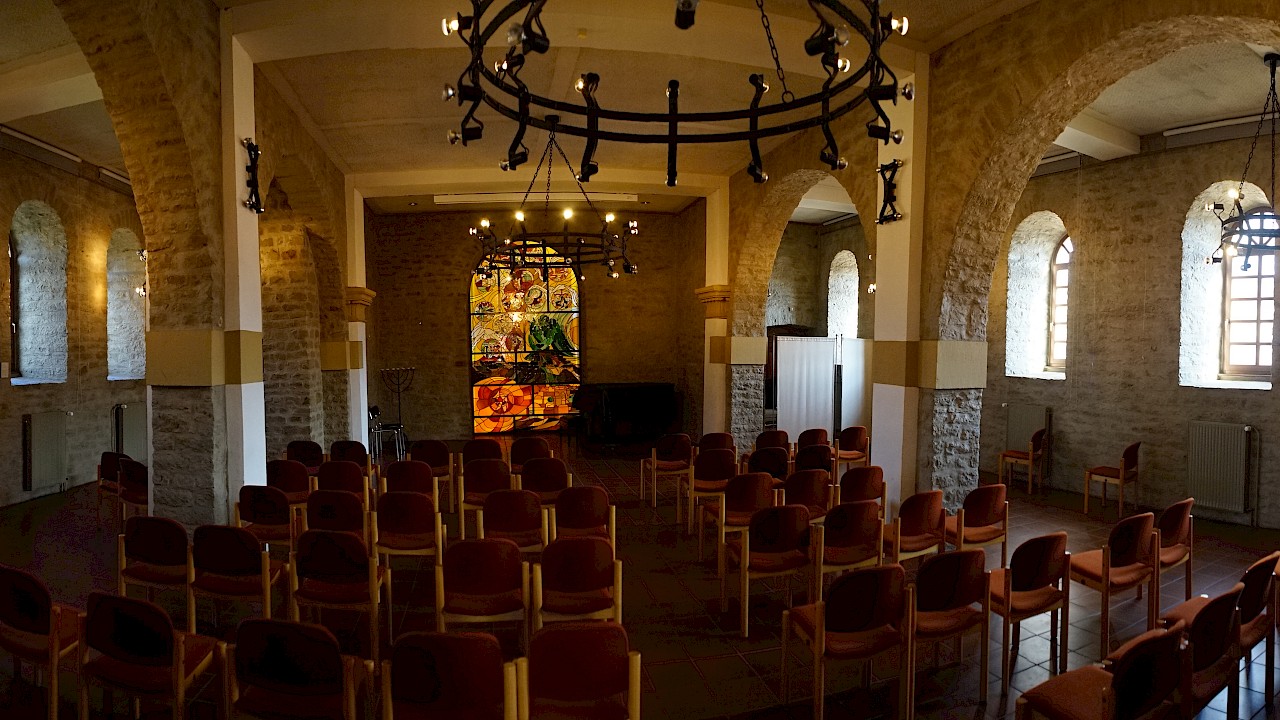
The “Friends and Supporters Association of Meisenheim Synagogue” purchases the building of the town’s former synagogue in 1986. After the completion of successful extension and development work, it is opened to the public as the Haus der Begegnung (House of Encounters).
Nowadays, the building is used as a venue for presentations, concerts and teaching and also contains a permanent exhibition on the history of Judaism in the Naheland region, as well as a special library containing Judaica.
By signing the Washington Principles on Nazi-Confiscated Art, governments commit to identifying works of art confiscated as a result of National Socialist persecution. They declare that they will strive to find fair and just solutions together with the owners and inheritors of the works. The national and municipal authorities in Germany commit to comply with the Washington Principles in a “joint statement” published in 1999.
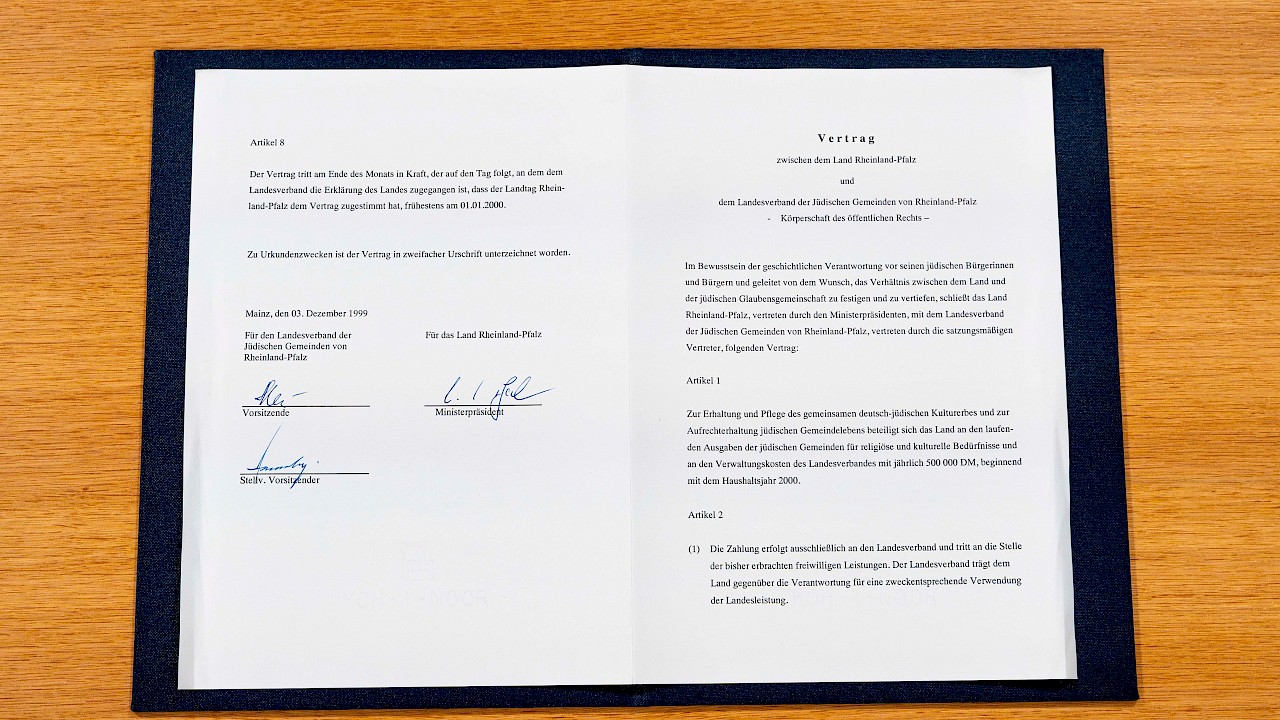
In December 1999, the state agreement between Rhineland-Palatinate and the State Association of Jewish Communities in Rhineland-Palatinate is signed. The agreement aims to support the work of the State Association. This includes the provision of annual financial support, which is passed on to the member communities.
wird geladen ...

 Android
 IPhone