 LMM Guide
Pogroms, persecution and the Shoah
As has been the case since ancient times, Jews continue to be wrongly blamed for epidemics and crises – even in Rhineland-Palatinate. These false accusations lead to violence, with pogroms such as those in 1096 at the start of the First Crusade or in 1349 during the plague costing thousands of lives. The protection guaranteed by the rulers often remains ineffective. The Shoah is the most severe affliction faced by the Jews. During the National Socialist dictatorship, the Jewish population is brutally eradicated. Despite the attempt to annihilate Jewish life, the first Jewish community in Rhineland-Palatinate following the Shoah is founded in Mainz on 17 October 1945.
“Only hearing such things will make a person’s ears ring. After all, who has ever heard or seen such a thing before? Ask yourself and see whether, since the beginning of humankind, there have even been so many sacrifices all on one day, all like the sacrifice of Isaac, the son of Abraham.”
Salomo bar Simson, around 1140
A significant number of families committed collective suicide during the riots of 1096 to avoid falling into the hands of the murderous mobs. This explains the comparison with Abraham, who was willing to sacrifice his son Isaac to prove his loyalty to God.
“On 23 Iyar, the wolves rose up against the community of Worms. Some members of the community were in their homes, and others were in the Bishop’s chamber. The enemies rose up against those who had stayed at home, looting their buildings and murdering young and old alike. They destroyed the houses, made tower blocks collapse, robbed and looted. They took the holy Torah, kicked it into the dirt of the alley and made it the subject of their mockery. They gorged on the Israelites with all of their muzzles.”
Eliezer ben Nathan, recorded in writing before 1146
The term “wolves” refers to the writings of the prophets Jeremiah and Zephaniah.
“Somebody once asked the Rabbi R. Meir if he needed atonement because on the day of incessant killing in Koblenz, the city of blood, he had killed his wife and children. They had requested that he commit such an act after realising that the wrath of God had flared up and the enemies had already started to sacrifice the Israelites, who were forced to suffer death to sanctify the Holy Name. He wanted to subject himself to the same fate with his own hands, but with God’s help, Christians prevented him from doing so.”
This question was asked by a survivor of the pogrom in Koblenz in 1263.
Rabbi Meir of Rothenburg answered with a forgiving response, stating that the killings were carried out under duress.
“When two young people wearing uniform [...] were placed in front of my shop on 1 April [1933], holding a sign saying 'Germans avoid Jewish shops', I went outside my shop door with my military decorations. This clash of colours allegedly […] had a provocative effect. After about an hour, the police, supported by members of the SA and SS, [took] me away and kept me in custody for half a day.”
Siegfried Wurmser (1893, Worms – 1973, Sao Paulo)
“The pinnacle was on 10 November 1938, when every single synagogue in Germany was destroyed and many appalling things happened that cry out for vengeance. I had just spent three weeks at the housekeeping school in Frankfurt and had to return home to Worms. When I stepped into our flat, I was greeted by shards of glass, broken fragments everywhere I looked. Fortunately, Papa was out of town, so he avoided being taken to the concentration camp.”
Miriam Gerber, née Sondheimer (1922 – 2021), in her diary in 1940
Miriam Gerber, née Sondheimer (1922 – 2021), in her diary in 1940, following deportation to the Gurs [internment camp}{Internment camp A state-run detention facility used to isolate individuals or groups from the rest of the population. Not a place of systematic forced labour or murder (concentration camp).} in the south of France. She ultimately made her way to the USA via the Dominican Republic.
“We didn’t have a flat any more, but some good Jewish friends took us in and let us sleep at their house for the last few weeks. […] I often look back on those final days. We still managed to visit the elderly Jewish people in Wittlich to bid them farewell. The others came to us. They came and went without saying much. […] Many of those who hoped to see us again are now gone. They are buried in the soils of Mauthausen, Bergen-Belsen, Dachau and other extermination camps. […] When I think about all our friends, about the big and small children, their parents and their grandparents, I pray that we will never face such times again, that nobody will be persecuted due to their religion or race, that swords will be beaten into ploughshares, and that the world will be as beautiful as it was during my childhood in Wittlich before 1933.”
Trude Wittner (1921 – 2017), remembering her upcoming departure to Palestine in 1937
“We, especially our dear mother, are hard at work due to our move. This is because […] we have to leave our current flat on the 29th and we have a lot to clear out. Because we can only keep the essentials for daily use in our one single room […].”
Heinrich and Selma Wolff on 17 September 1941 to their sons in New York
Heinrich and Selma Wolff on 17 September 1941 to their sons in New York, before their ordered move to the “Judenhaus” (House of Jews) at Rheinallee 3. Their final letter to New York dates back to 22 November 1941, before they were deported and murdered in 1942. Two “Stolpersteine” memorial blocks in Eleonorenstraße in Mainz-Kastel now commemorate the married couple.
“And on the eighth of Iyar, the Shabbat, the enemies rose up against the community of Speyer and killed ten of its holy souls who had sanctified their Creator on the holy Sabbath. There was a pious woman at the scene, and she slaughtered herself to sanctify the name [of God].”
Eliezer ben Nathan, recorded in writing before 1146
By killing themselves, the persecuted Jews were able to avoid forced baptism. The Bishop of Speyer intervened and prohibited the forced baptisms.
“It happened as they passed through the towns where there were Jews. They spoke to each other, saying, ‘Come, we have embarked on a mission to seek our ignominy and to take our revenge on the Muslims, but it was actually the Jews who killed Him and nailed Him to the cross.
Come, let us take vengeance on them and eradicate them from the nations so that the name of Israel will cease to be remembered – unless they become like us and profess their faith [in the Christian God].’”
Eliezer ben Nathan, recorded in writing before 1146
In 1095, Pope Urban II summoned his people to capture Jerusalem, with the aim of regaining Christian possession of the tomb of Christ and the places where Christ had worked. Within the context of this First Crusade, violent attacks were carried out on Jewish communities, especially those situated along the Rhine.
This year I by-passed you.
I did not want to see Your sandstone spires,
nor feel the pavements rise
Against my feet.
For she, the child, who knew
Each window, gate, and leaf,
And still returns
In sleep and waking pain,
Cannot return.
To keep a root secure
I place its constant need
Into my blood;
And lock that early love
into the blackened Rhine.
Lotte Kramer
Lotte Kramer (born in Mainz in 1923) arrived in Great Britain on one of the last „Kindertransports“ in 1939. Her parents were murdered in a concentration camp. In this poem, she expresses her conflicting feelings when she sees her hometown of Mainz. It certainly reflects the feelings of many people who were forced to emigrate.
“I was displaced to Theresienstadt in 1942 and I am one of just a few people who were able to leave there and return to their home towns. […]
My sister, the teacher Miss Johanna Sichel, who was well known in Mainz, was gassed in Auschwitz. My brother, the lawyer Dr Bertram Sichel, died from a heart attack following the commotion of 1940. My second sister, Ms Regina Beck, avoided being transported to Theresienstadt by committing suicide in 1942. My third sister, Dr Hölzer, took her own life for obvious reasons in 1945.”
Henriette Sichel (1875 – 1961)
Henriette Sichel (1875 – 1961) in a letter sent to the Ministry of Finance in 1949, requesting that it check her entitlement to a pension or compensation for her assets, which had been confiscated since 1938. The decision was negative.
–
“Here, the enemies rose up against them and wilfully killed infants and women, boys and elderly men on one single day, not even taking pity on heavily pregnant women. The sun and the moon, why didn’t they go dark when one thousand three hundred holy souls were killed on one single day?
On the same day, sixty souls were saved in the cathedral treasury.
In every place where a Jew fled to save their life, the stone cries out from the wall.”
Eliezer ben Nathan, recorded in writing before 1146
He experienced the massacre in Mainz in 1096 as a child and an eyewitness.
“The great oppression of the Jews began with the crusades, and raged most furiously about the middle of the fourteenth century, at the end of the great pestilence, which was, like all other great public disasters, attributed to the Jews, because people declared they had drawn down the wrath of God, and with the help of the lepers had poisoned the wells. […] There was another accusation which had come down from earlier times, and which through all the Middle Ages, even to the beginning of the last century, cost much blood and suffering. This was the ridiculous story, often repeated in chronicle and legend, that the Jews stole the consecrated wafer, and stabbed it through with knives till blood ran from it. And to this it was added that at the feast of the Passover the Jews slew Christian children to use their blood in the night sacrifice.”[MH1]
Heinrich Heine, from: The Rabbi of Bacharach, 1840
“A large crowd of people had now gathered in front of the building. We [six members of the Jewish community] were forced to surrender our clothes, prayer books and other religious garments and to throw them into a large bonfire that had been lit by the Nazis. They also made us burn the Holy Bible.
We were forced to play along with this game of stoking the fire until it had consumed the very last Jewish religious object."
Report from Leo Fränkel (1893 – 1971) from 1 March 1946
Report from Leo Fränkel (1893 – 1971) from 1 March 1946 on the desecration and looting of the synagogue in Guntersblum on 10 November 1938
“On this day in Mainz, for the sake of His great name – which is unique in His world; apart from Him, there is no God – a thousand holy souls were killed, with the exception of Rabbi Kalonymus, the righteous leader, and some of the young people of Israel with him.”
Salomo bar Simson, around 1140
“Now it’s getting serious: We will be taken away from here on Friday and we will initially go to Theresienstadt, or first to Frankfurt. I had actually firmly decided to end it all this evening and be taken to my grave in Bad Ems on Friday, but I’m unlucky enough that even these plans have to be cancelled because everything came so suddenly. […] I had a large parcel sent off to you today. The content is for you, but save the breakfast basket for the children because there is a second one too. And now it’s time for me to bid you a fond and loving farewell, for I will never see you again!”
Farewell letter from Fanny Königsberger from 25 August 1941, sent to a friend
Farewell letter from Fanny Königsberger (1866 – 1942) from 25 August 1941, sent to a friend before she was deported from Bad Ems to Theresienstadt
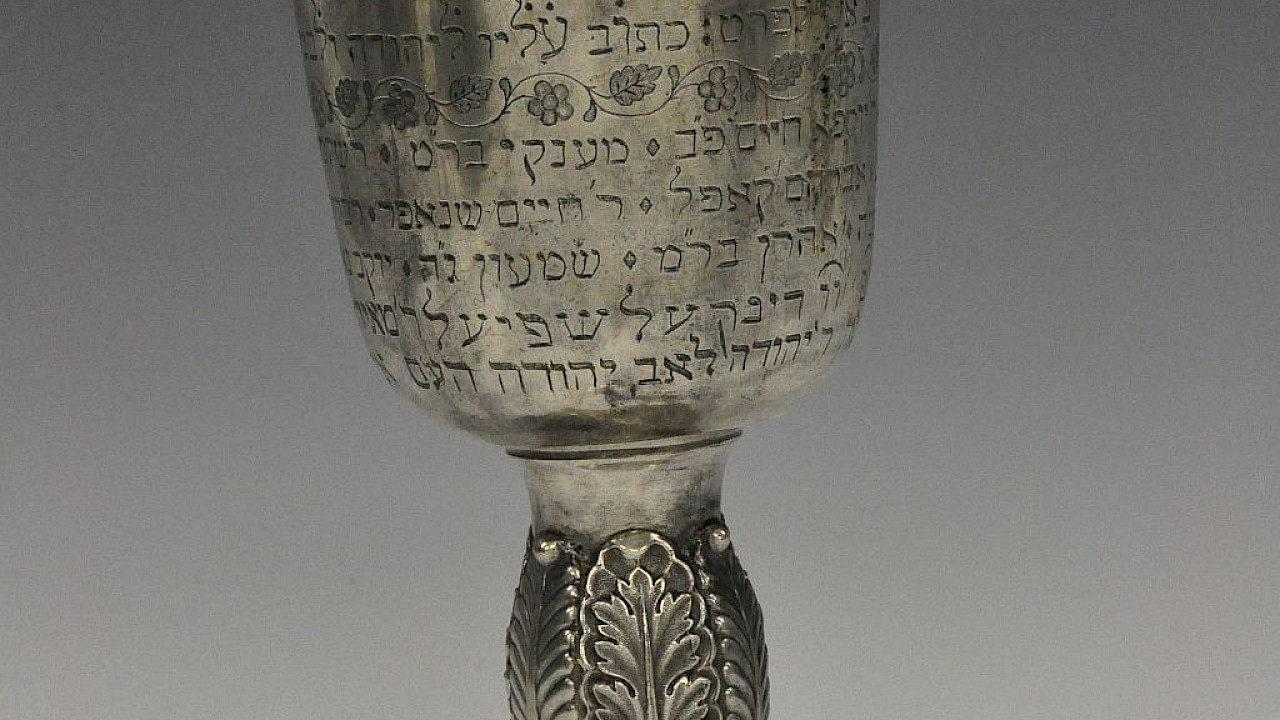
The inscriptions name the Bingen-based Rabbi Moses Meir Lebrecht and mention several other names that can also be found in the local cemetery, as well as further names that can be connected with Mainz. The damage is clear evidence of vandalisation, namely somebody bashing the cup against a hard edge. The museum deliberately did not repair the damage because it is part of the item’s history. Although those involved in the arson attacks on [synagogues}{Synagogue Sacred Jewish building for gatherings, services and social and cultural events within the Jewish community.}, shops and private properties as part of the November [pogroms]{Pogrom Violent attacks by the local non-Jewish population on Jews that are supported or at least tolerated by the government or the ruler.in 1938 are told to destroy, they are not instructed to loot.
wird geladen ...

 Android
 IPhone