 LMM Guide
Audio
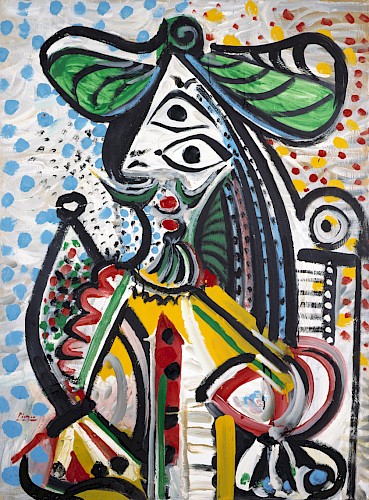
Pablo Picasso, Homme assis, 1970, oil/canvas, Inv.-Nr. GE 81/40
GDKE, Landesmuseum Mainz
An older ego
The "Seated Man" from 1970 is part of a series of self-portraits that were one of the driving forces of Picasso's later work. In these portraits, the painter liked to slip into different roles and depict himself as for example a Spanish matador, a French musketeer, or the artist Rembrandt. For him, the confrontation with his alter ego was a tireless and labour-intensive process. There are not merely two or five portraits, but hundreds of pictures, painted with quick, expressive brushstrokes and bold colours - his characteristic style. The black contours make the figure stand out against the background. Picasso did not want to give up the figurative.
In this work, he meets the viewer enthroned and "disguised" as a Dutch painter. His claw-like hands seem to powerfully grip the two arm rests of the throne. He does not let go, but digs his fingers in firmly.
Picasso's late works were often criticised. It was said he could no longer draw with a steady hand in his old age. Picasso firmly denied these allegations. At the age of 92, he drew a perfect circle on paper with a pencil without breaking off the line.

(GDKE, Landesmuseum Mainz)
Dieses Audio ist leider nur auf Deutsch verfügbar.
(GDKE, Landesmuseum Mainz)
Dieses Audio ist leider nur auf Deutsch verfügbar.
(GDKE, Landesmuseum Mainz)
Dieses Audio ist leider nur auf Deutsch verfügbar.


mobilewebguide LMM Guide
wird geladen ...

Ein Angebot von satelles.de:
erfahren - erleben - entdecken
 Android
 IPhone