 LMM Guide
Audio
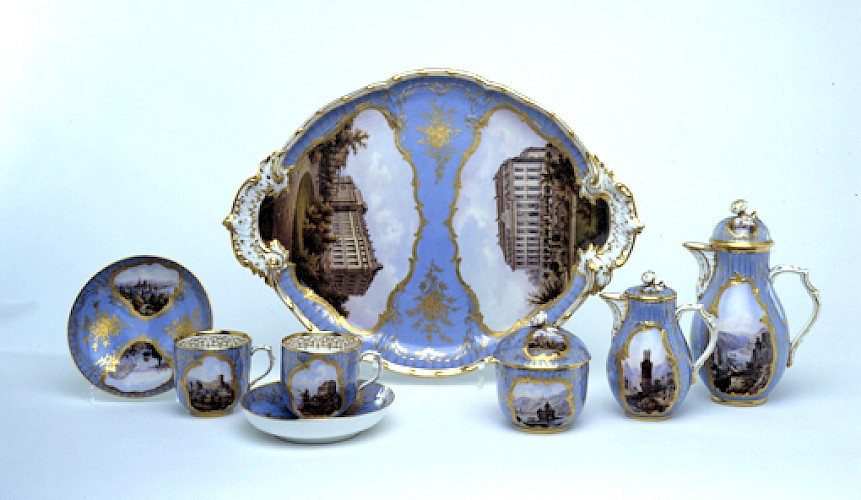
Royal Porcelain Factory, Berlin - Déjeuner with Rhineland views
GDKE, Landesmuseum Mainz
Traveling down the Rhine during breakfast
The set is complete- it is meant for two people and is therefore referred to as 'tête-à-tête.' 'Déjeuner' suggests that it was likely used for (a second) breakfast when only coffee and pastries were served. This one was never used, however: scratches or worse on the precious, delicate surface would have been too annoying. It displays views of Heidelberg, Mainz (on one of the saucers), Rüdesheim, Bingen, Rheinstein Castle near Trechtingshausen, Bacharach, Kaub with the Palatinate, Oberwesel, Rheinfels Castle above Sankt Goar, Marksburg, Bad Ems und Andernach und Rheineck Castle near Bad Breisig. Particularly representative views on the tray include the Electoral Palace in Koblenz and the Augustusburg Palace near Brühl.
The Rhine comes to Prussia
This is meant literally, as the above-mentioned views of the Rhine were painted on porcelains of the series ''relief decoration with rods" by the Royal Porcelain Manufacture. This custom-made piece from 1865, with its delicate yet atmospheric hand-painting, might have been a typical present for someone close to the Prussian court in Berlin. The Rhineland had been a Prussian province from Bingerbrück to the Dutch border since 1815. The Electoral Palace in Koblenz was the center of the administrative district of the same name, and from 1823, Rheinstein Castle had been restored by a Hohenzollern prince. Augustusburg Palace served as the court's lodgings in the Rhineland, and Queen Victoria was received there in 1845. In a unique way, the set places Rhine romanticism within a Rococo context while highlighting Prussia's presence along the Rhine.

Additional information: The Rhine comes to Prussia (GDKE, LMMZ)


mobilewebguide LMM Guide
wird geladen ...

Ein Angebot von satelles.de:
erfahren - erleben - entdecken
 Android
 IPhone