 LMM Guide
Audio
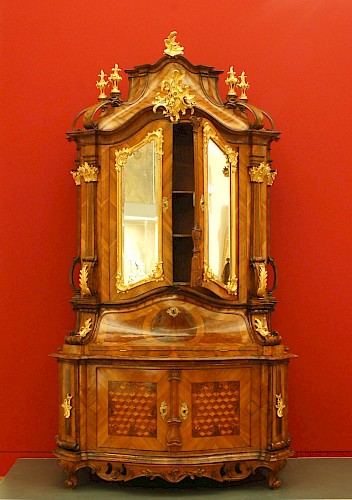
Peter Schuß (around 1730-1773) Writing cabinet (so-called "Cantourgen"), 1763 Various woods, mirror glass and metal fittings Inv. no. KH 1990/16
GDKE, Landesmuseum Mainz
Everything made by one Hand
In 1762, the journeyman Peter Schuß submitted the designs for a piece of furniture to the Mainz carpenters' guild. Six months later, he delivered his masterpiece. He himself had carried out almost all the work on it without any further help.
We no longer see anything of the actual framework of the cabinet, as the softwood is completely covered with so-called "marquetry": millimetre-thin pieces of veneer made from various woods cover the body like a skin.
When you open the cabinet, you can go on a real journey of discovery, as the interior conceals both obvious drawers and secret compartments and ingenious mechanisms.
"Cantourgen" is pronounced "Ganturschen" in Mainz, derived from the French "comptoir" or Latin "contor" for such a writing cabinet.
Luxury and rationalism
A magnificent piece of furniture such as Peter Schuß's writing cabinet was made by hand. The budding carpenter had to master all the different steps and the various techniques. He was also responsible for the design. He worked for a specific customer, who often had to pay in advance.

Additional information: Luxury and rationalism (GDKE, LMMZ)


mobilewebguide LMM Guide
wird geladen ...

Ein Angebot von satelles.de:
erfahren - erleben - entdecken
 Android
 IPhone