 LMM Guide
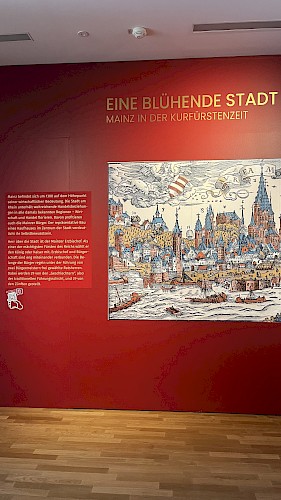
A thriving city. Mainz in the Elector era
GDKE, Landesmuseum Mainz
A thriving city. Mainz in the Elector era
Mainz was at the peak of its economic importance around 1300. The city on the Rhine maintained extensive trade relations with all regions that were known at that time – economy and trade flourish. The citizens of Mainz also benefitted from this. The representative construction of a department store in the city centre illustrates its self-confidence.
The Archbishop of Mainz was the lord of the city. As one of the most powerful princes of the empire, he helped elect the king or emperor. The archbishop and the citizenry were closely connected. Citizens' concerns were regulated by freely elected councillors under the leadership of two mayors. Of these councillors, 29 were provided by the “houses", i.e. the traditional ruling class, and 29 by the guilds.
Mainz was an impressive sight. The centre behind the city wall along the Rhine was densely built-up. This is where the cathedral, numerous churches and monasteries, as well as also patrician and burgher houses as half-timbered or stone buildings arose. Street names testified to the resident crafts, trades, markets and institutions, such as Fischer- and Heugasse (fish and hay lane), Eisen- and Flachsmarkt (iron and flax market), Unter den Schmieden (under the blacksmith’s) and Unter den Hutmachern (under the hat maker’s) as well as Augustinergasse which is named after its monastery. The Mainz district also included villages outside the city walls, such as Hechtsheim, Gonsenheim and Mombach. They were subject to Mainz’s secular court.


mobilewebguide LMM Guide
wird geladen ...

Ein Angebot von satelles.de:
erfahren - erleben - entdecken
 Android
 IPhone